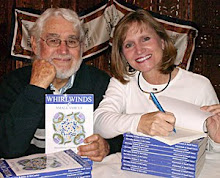
Recently in our newspaper that covers the middle section of our state I noticed this headline: PRIZE-WINNING AUTHOR TO SPEAK ON WATER. Well, I thought, maybe that means he/she will stand on a bridge and speak to people in the water. Maybe it means the speaker will stand in shallow water and speak to people on the shore. I could see several possibilities to this event of a water speaking author. If there was any possibility the speaker was actually going to stand on top of the water I definitely wanted to be there. I've never seen anyone walk on water in the Galilean sense, I never did it myself and I don't think I'd actually want to be there if I tried, I don't really trust my butterfly stroke. I swim through the water, I stand under the water while showering, and I fly over the water while in an airplane. Walking on water has just never been my thing. Actually doing it in the Galilean sense is called a miracle as in Matthew 14.
Yet the thing is, I've actually seen miracles. Webster defines miracle as, "An extremely outstanding or unusual event, thing, or accomplishment." OK, I've never seen anybody walk on the water but I've seen a teenager suddenly, unexpectedly, against the odds, go into remission. That hospital room rose up in one united shout of joy when the news was delivered to the family. Know how many miracles take place every day when someone is cured of alcoholism or drug addiction? IT'S LIKE WALKING ON WATER! I've seen a 3 day old baby undergo surgery for cornea cancer and given sight. I've seen a distraught mother pulled back from the brink of a bridge when overwhelmed with despair, saved by love no less. I've seen a young doctor who might earn $ 400,000 a year in a lucrative practice give his whole life to the poor in the slums of La Paz, Bolivia, his name is Charles Peterson. Whenever I hear someone call it a miracle when Jesus walked on the water I respond, "Absolutely!" When I see or hear of a child being delivered safely in childbirth I say, "A miracle, absolutely!" Jesus affirmed in Matthew 14 that believers can walk on the water. Yes, and when that water is the water of Easter newness, of cleansing, renewing, rising up, overcoming, seizing hope, we truly, honestly, victoriously, walk out into the light of the Easter hope. "Come to me," Jesus said to Peter, "Walk with me here where it’s deep and uncertain." No, not to a rose garden, just a daily walk to life's beauty in the Easter Promise.
Monday, April 2, 2012

Friday, March 23, 2012
LEARNING TO BE HAPPY
One of the most moving and heartbreaking/heartwarming films I know of is the 1996 French film, "Ponette." The role of Ponette is played by 4 year old Victorie Thivisol. Her role in the 96 minute film is almost entirely unscripted, nearly extemporaneous. Ponette has recently lost her mother in a car accident and because her father travels for a living he sends Ponette to live with relatives. Ponette searches desperately for her mother wherever she thinks her mother might be and wondering all the while why her mother doesn't come to get her. The child's playmates at school play tricks on her claiming the tricks will bring back her mother. There are also playmates who befriend her as best they can. Near the end of the film Ponette, in a desperate search for her mother, leaves her school room, goes to the burial ground, and begins to dig into the grave of her mother. Exhausted, crying in grief and despair, Ponette suddenly sees her mother. Child and mother embrace, crying in happiness. There are consolations, kisses, mother and child becoming one in true mother-daughter spirit. Of course the mother is a fantasy, a chimera, a need fulfilled for the child. The mother says all the right things to her child, always being with her in spirit, always seeing, always understanding, always knowing, always loving. When Ponette walks away from her mother's grave to return to the classroom she is satisfied that her mother is still with her and that she, Ponette, will never be truly alone again. Ponette narrates the ending of the film by saying, "She told me to learn to be happy."
I love that line. It tells me we aren't born happy which is the reason 85% of people will answer, "Just to be happy," when asked what they would like to have more than anything else in the world.
Yet we know that nothing exterior to us can make us happy. No person can make us happy. Happiness, as Ponette says, is something that is learned from life's experiences. We are happy as we learn to incorporate life's unhappiness, its sorrows, its grief, loss, disappointment, loneliness, into a broadening of our interests, our friendships, our intimacies, our time, our cultivation of life's ready-to-go gifts, our challenges and even life's dangers, to plunge into the wealth and riches of daily life as it comes to us. We can learn to be happy. It comes when, above all else, we have learned not to be unhappy.
I love that line. It tells me we aren't born happy which is the reason 85% of people will answer, "Just to be happy," when asked what they would like to have more than anything else in the world.
Yet we know that nothing exterior to us can make us happy. No person can make us happy. Happiness, as Ponette says, is something that is learned from life's experiences. We are happy as we learn to incorporate life's unhappiness, its sorrows, its grief, loss, disappointment, loneliness, into a broadening of our interests, our friendships, our intimacies, our time, our cultivation of life's ready-to-go gifts, our challenges and even life's dangers, to plunge into the wealth and riches of daily life as it comes to us. We can learn to be happy. It comes when, above all else, we have learned not to be unhappy.
Subscribe to:
Posts (Atom)

 Posts
Posts

